

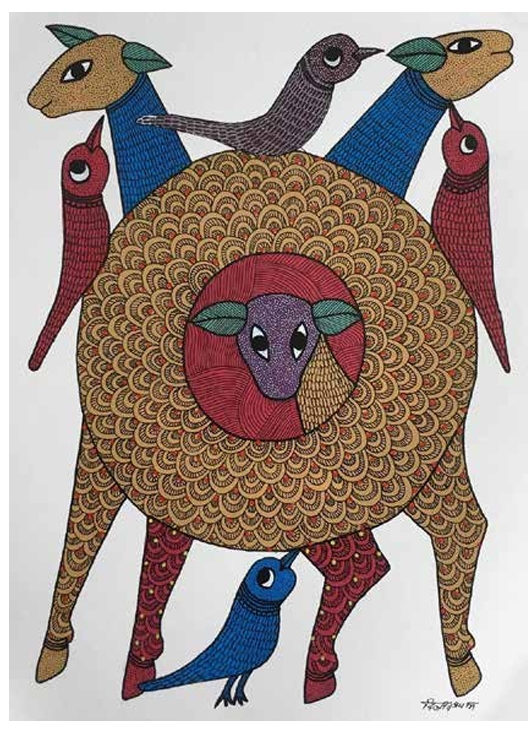
A sea of floral and faunal motifs, set in a vibrant colour palette, featuring geometric figures of humans and beasts alike, transports one into the realm of Gond tribal art. An Adivasi art form that had been overlooked for centuries was brought into the spotlight by the artist milieu of J. Swaminathan on his visit to Bhopal, when he discovered the lauded artist who melded the Gond traditions with the elements of contemporary evolution to inaugurate a new epoch for Gond art and artists henceforth. In the world of Gond tribal art, the name and legacy of Jangarh Singh Shyam stand unrivalled. A pioneer of the revival of the tribal art form of the Gond Pardhans of Central India, Jangarh Singh Shyam translated personal subjects and vision into powerful imagery, crafting a niche form that arose not on walls, but on pen and paper—called the Jangarh Kalam.
Jangarh belonged to the community of Pardhans, one of the major Gond tribes, whose ritualistic role was embodied in the preservation and furthering of the oral folklore and sacred songs. The shadows of these roles are cast clear and wide in Jangarh’s own work. Owing to colonial and post-colonial systemic oppression, the Pardhans resorted to agricultural labour, abandoning their role in passing down the mythical and folk stories depicted in their art.
Jangarh Singh Shyam’s work is thoroughly defined with an unparalleled ingenuity. His experimentation in rendering tribal Gond art in print, tangible visualization of Adivasi deities, and excavating the heritage and cultural symbols of the Pardhan community, including the stringed instrument bana, preceded the global intrigue into the traditional roots and progressive emergence of Gond art, positioning Adivasi art as a distinct genre in itself.
Conferro in Conversation with Dilip Shyam
Jangarh Singh Shyam’s influence runs deep in the vicinity of his life. Paternal uncle to the acclaimed Gond artist Dilip Shyam, Jangarh Singh Shyam was a primary influence upon the artist.
Growing up, Shyam would often look at the works of his uncle, and try to recreate them with color in his books. During Diwali, when Uncle Jangarh would paint the walls of the community spaces in the village with images of cows, representing the Hindu Goddess Lakshmi, a young Dilip would be filled with joy and admiration.
“You must carve your own mark, create your own identity”
The words carry the idea behind Dilip Shyam’s work. His uncle’s advice about not copying anyone made him delve deeper into the realms of his imagination and storytelling. This introspection led to the birth of Dilip Shyam’s distinct voice.
Inspired by the machhiya, the weaving pattern on a traditional cot, and gehu ki baali, the grain ears that appear on growing wheat, Shyam decided to incorporate these mundane yet crucial personal and communal images into his work, as his signature characteristic. Another motif that appears in his work is the Dhigna, the traditional geometric patterns painted on the wall. Shyam attributes the birth of Gond art to the conception and creation of Dhigna.
Dilip Shyam’s works are not only rich in color and vibrancy. Their strong aesthetics have placed them in significant personal and organizational collections worldwide, including Conferro Heritae’s own expansive inventory.